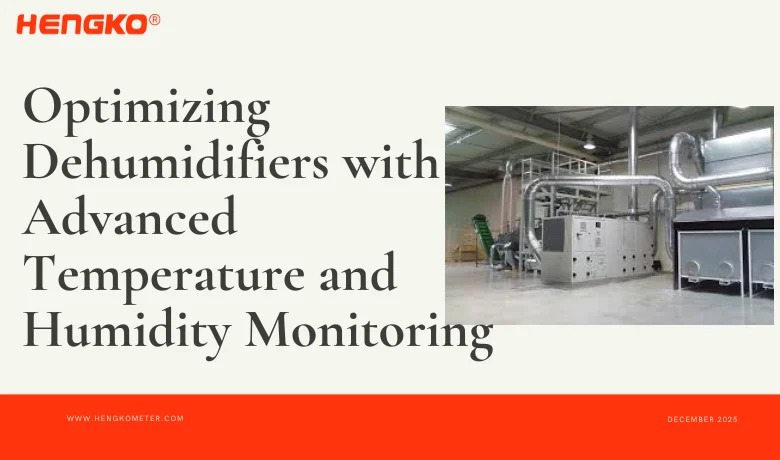
Effective moisture management is essential in facilities where materials, equipment, and processes depend on controlled environmental conditions. While dehumidifiers play a central role, their performance—and efficiency—largely depends on accurate temperature and humidity monitoring. With advanced transmitters providing continuous, real-time environmental data, dehumidifiers can operate intelligently rather than blindly, ensuring consistent protection and optimal operating costs.
This article explores why monitoring matters, how it enhances dehumidifier performance, and how high-precision sensors from Hengko elevate moisture-control systems across industries.
The Role of Temperature and Humidity Monitoring
Temperature and humidity transmitters are the “brains” behind modern dehumidification systems. They continuously measure real-time environmental conditions and feed these signals to the control system, enabling dynamic operation instead of fixed, inefficient run cycles.
Without accurate monitoring:
-
Over-drying wastes energy and damages sensitive materials such as archival paper, electronics, and certain industrial parts.
-
Under-drying leaves environments exposed to corrosion, mold growth, condensation, and degradation of raw materials.
Advanced monitoring ensures that dehumidifiers respond precisely to environmental changes—maintaining ideal indoor conditions, reducing risk, and improving operational stability.
Enhancing Energy Efficiency
Energy efficiency is a critical consideration for facilities that operate large-scale dehumidification systems. Traditional dehumidifiers often run continuously or on preset schedules, leading to unnecessary energy consumption. Advanced temperature and humidity transmitters allow smart operation by adjusting fan speed, compressor activity, and other parameters based on real-time conditions.
For example, if a warehouse is less humid in the early morning, the dehumidifier can operate at a lower capacity, conserving energy without compromising air quality. As humidity rises during the day, the system automatically ramps up to maintain the target level. This dynamic control not only reduces operational costs but also extends the lifespan of the dehumidifier by preventing constant, high-intensity operation.
Protecting Sensitive Equipment and Products
Many industries rely on strict humidity control to protect valuable assets. Integrating reliable transmitters ensures that dehumidifiers maintain stable environmental conditions—even during sudden humidity fluctuations.
Examples of moisture-sensitive scenarios:
-
Pharmaceutical storage: Humidity stability prevents loss of potency and ensures compliance with GMP and regulatory standards.
-
Food warehousing: Controlled humidity reduces mold risk, extends shelf life, and maintains product texture.
-
Electronics manufacturing: Proper humidity prevents condensation, electrostatic discharge (ESD), and corrosion.
-
Museum preservation: Artworks, archival documents, and historical items require tight RH control to prevent fading, warping, and degradation.
-
Machinery and precision tools: Moisture accelerates rust and affects accuracy in high-precision manufacturing.
With high-accuracy monitoring, dehumidifiers maintain consistent control—protecting materials, avoiding spoilage, and preventing costly downtime.
Predictive Maintenance and System Reliability
Another significant advantage of temperature and humidity monitoring is its role in predictive maintenance. By tracking environmental trends over time, facility managers can identify potential system inefficiencies or failures before they escalate into costly problems.
For example, a gradual rise in humidity may indicate a failing dehumidifier component, air leakage, or inadequate insulation in the facility. Early detection allows for timely maintenance, reducing downtime and minimizing repair costs. This predictive capability ensures not only operational reliability but also the continuous protection of sensitive materials and equipment.
Data-Driven Control and Remote Monitoring
Modern temperature and humidity transmitters often come equipped with digital interfaces that support data logging, cloud integration, and remote monitoring. This enables centralized management of multiple dehumidifiers across different locations. Alerts can be sent automatically if conditions deviate from the desired range, allowing managers to take immediate corrective action.
For example, a facility manager overseeing multiple warehouses can monitor real-time humidity and temperature readings from a smartphone or computer. Any anomalies trigger instant notifications, ensuring that all environments remain within target ranges—even without physical presence. This data-driven approach improves operational efficiency, reduces human error, and provides actionable insights for long-term planning.
Application Scenarios
Temperature and humidity monitoring is essential across a wide range of industries and facilities:
-
Industrial Storage: Raw materials and finished goods are protected from moisture damage, reducing losses and maintaining product quality.
-
Laboratories and Clean Rooms: Controlled conditions are critical for experiments, testing, and production of sensitive products.
-
Server Rooms and Data Centers: Preventing condensation and high humidity levels protects servers and IT equipment from short circuits and corrosion.
-
Museums and Archives: Artifacts, documents, and historical items require consistent environmental conditions to prevent degradation.
-
Pharmaceutical and Food Storage: Maintaining precise humidity ensures product efficacy, safety, and compliance with regulatory standards.
Choosing the Right Temperature & Humidity Transmitter
Selecting the appropriate temperature and humidity transmitter is crucial for reliable performance. Key considerations include:
-
Measurement range and accuracy: Ensures sensors are suitable for the specific environment and required precision.
-
Response time: Rapid detection allows dehumidifiers to react promptly to changes.
-
Durability: Sensors must withstand high humidity, temperature fluctuations, and exposure to chemicals or dust.
-
Output compatibility: Both analog and digital outputs are necessary to integrate seamlessly with existing dehumidifier control systems.
At Hengko, our high-precision transmitters offer robust performance under diverse conditions, providing reliable environmental data to optimize dehumidifier operation and protect valuable assets.
Why Choose Hengko Sensors for Dehumidification Systems
Hengko’s high-precision temperature and humidity transmitters are engineered for demanding applications:
-
High stability and long-term accuracy
-
Fast response time
-
Robust stainless steel or industrial-grade housing
-
Optional high-temperature probes
-
Strong anti-interference performance
-
Analog & digital outputs compatible with most dehumidifier control systems
-
Customizable probe length, mounting, and measurement range
Whether used in industrial warehouses, precision labs, or large-scale production facilities, Hengko sensors provide the reliable environmental data needed for smarter dehumidification and stronger protection.
Kesimpulan
Integrating advanced temperature and humidity monitoring into dehumidifier systems is no longer optional—it is a safeguard for both operational efficiency and material protection. By enabling energy-efficient operation, preventing moisture-related damage, and supporting predictive maintenance, these sensors ensure that dehumidifiers perform at their best.
For industries and facilities where moisture control is critical, leveraging precise environmental data is key to success. Hengko’s high-quality transmitters deliver the accuracy, stability, and reliability necessary to optimize dehumidification systems, making them an essential component of modern moisture control strategies.