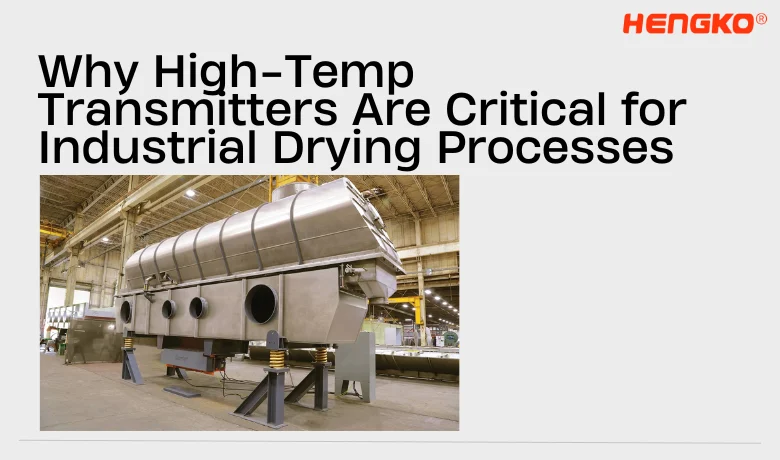
How to Monitor Temperature and Humidity in High-Temperature Industrial Drying Processes
Industrial drying processes used in pharmaceuticals, food production, chemicals, ceramics, and materials manufacturing require precise control of temperature and humidity. Even small deviations can cause product defects, excessive energy consumption, longer drying cycles, or equipment damage.
This guide explains why high-temperature drying environments must be monitored, where sensors should be installed, how industrial transmitters operate, and how the HENGKO HG808-T can integrate with PLC, DCS, and SCADA systems for continuous process control.
In This Article
1. Why temperature and humidity monitoring matters in industrial drying
2. What can go wrong without accurate monitoring
3. Where to install sensors in a drying system
4. How the HG808-T works in high-temperature applications
5. How to use measurement trends to improve drying efficiency
6. How to configure practical alarm thresholds
7. How to specify, integrate, and commission the transmitter
8. Frequently asked questions
Key Takeaways
✓ Temperature determines the drying capacity of the air, while humidity indicates how effectively moisture is being removed.
✓ Monitoring temperature alone does not provide enough information to control product dryness consistently.
✓ Sensor location directly affects the usefulness and accuracy of the process data.
✓ Trend data can reveal filter blockage, heater instability, airflow imbalance, leaks, and changing product loads.
✓ Industrial outputs such as 4–20 mA and Modbus RTU allow transmitters to support alarms, control loops, logging, and predictive maintenance.
Why Monitor Temperature and Humidity in High-Temperature Drying?
Industrial drying is not simply a matter of applying heat. Effective drying depends on the interaction between air temperature, moisture content, airflow, product load, and residence time.
Temperature determines how much moisture the air can hold and how quickly evaporation can occur. Relative humidity indicates how close the air is to saturation and how much additional moisture it can absorb from the product.
Monitoring both parameters gives operators a much clearer picture of drying performance than monitoring temperature alone.
What Does the HG808-T Measure?
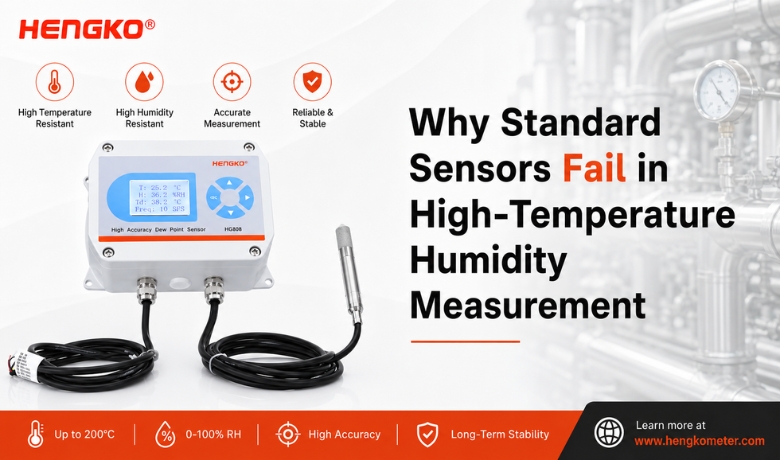
The HENGKO HG808-T is designed to measure air temperature and relative humidity in high-temperature process environments such as drying chambers, ovens, kilns, heated ducts, and industrial exhaust systems.
These measurements help operators evaluate:
- Moisture removal efficiency
- Drying-air capacity
- Product consistency
- Energy consumption
- Process stability
- Equipment operating condition
In a drying process, temperature represents the thermal energy available for evaporation, while humidity indicates how much moisture the air has already absorbed. Reliable drying control therefore requires both measurements.
What Goes Wrong Without Accurate Monitoring?
Poor temperature and humidity control can affect product quality, energy efficiency, equipment life, and plant safety. The following problems are common in poorly monitored drying systems.
1. Over-Drying or Under-Drying
When humidity is not monitored accurately, operators may continue heating even after sufficient moisture has been removed. This can cause over-drying, brittleness, shrinkage, discoloration, or loss of product performance.
Under-drying creates a different set of problems. Residual moisture may cause uneven powders, cracked ceramics, reduced shelf life, coating defects, microbial risks, or unstable downstream processing.
Continuous monitoring helps detect humidity deviations before they result in scrap, rework, or inconsistent product quality.
2. Energy Waste
Without reliable process data, drying systems may operate at unnecessarily high temperatures or continue running after the product has reached its required moisture level.
This may lead to:
- Excessive fuel or electricity consumption
- Longer-than-necessary drying cycles
- Higher exhaust losses
- Unnecessary heater operation
- Reduced production throughput
Continuous temperature and humidity monitoring allows operators to identify elevated baseline conditions and optimize heating, airflow, and cycle duration.
3. Equipment Stress
Uncontrolled process temperatures can overheat heater coils, motors, bearings, seals, fans, and electrical components.
Repeated overheating may shorten equipment life and increase the risk of sudden failure. Abnormal temperature spikes detected by the transmitter can provide early warning before serious damage occurs.
4. Safety Risks
High-temperature drying equipment can create hazardous conditions when leaks, condensation, blocked airflow, or uncontrolled heating are not detected promptly.
Potential risks include:
- Hot-air leakage
- Condensation dripping onto equipment
- Overheated components
- Damage to insulation or wiring
- Fire hazards in combustible processes
- Unsafe working conditions near the dryer
A rapid temperature or humidity excursion should be treated as a process warning, not simply as a measurement anomaly. It may indicate an airflow interruption, heater fault, leaking seal, changing product load, or condensation event.
Where to Place Sensors for Effective Monitoring
Sensor location has a major influence on the value of the collected data. A single sensor may not fully represent conditions across a large dryer, especially when airflow, product loading, or temperature distribution is uneven.
1. Dryer Inlet
A transmitter installed at the inlet verifies the condition of incoming drying air. It helps determine whether the preheater, humidifier, air-handling equipment, or recirculation system is operating correctly.
Inlet measurements can help identify:
- Insufficient preheating
- Unexpected moisture in incoming air
- Seasonal changes in ambient conditions
- Recirculated-air instability
- Air-treatment equipment problems
2. Drying Chamber
Sensors installed inside the drying chamber provide direct information about the conditions surrounding the product.
In larger chambers, multiple sensors may be required to detect hot spots, cold zones, uneven airflow, or different drying rates across the product load.
Chamber measurements are especially important when product quality depends on narrow temperature and humidity limits.
3. Dryer Outlet
The outlet is often one of the most useful measurement points because it reflects how much moisture the drying air has collected from the product.
Outlet measurements can help:
- Confirm that moisture removal is occurring
- Identify the end of the drying cycle
- Reduce over-drying
- Detect excessive residual moisture
- Compare drying performance between batches
4. Exhaust or Vent
A sensor installed in the exhaust or vent can support energy analysis, condensation prevention, and downstream equipment protection.
Exhaust monitoring may reveal:
- Excessive moisture leaving the dryer
- Condensation risk in ductwork
- Air leakage
- Poor heat-recovery performance
- Unstable recirculation conditions
Install at least one transmitter at the dryer inlet and another at the outlet. Comparing these two measurement points gives operators a clearer view of moisture pickup, drying effectiveness, and energy performance.
How HG808-T Transmitters Work in High-Temperature Applications
High-temperature drying environments require more than a conventional room humidity sensor. The complete measurement system must withstand prolonged heat exposure while protecting the sensing components and transmitter electronics.
High-Temperature Sensor Design
The HG808-T is designed for temperature measurement from -40°C to +200°C and for industrial humidity monitoring across the specified operating range.
A high-temperature transmitter may include:
- A high-temperature humidity sensing element
- An RTD temperature element
- A stainless steel probe assembly
- A protective porous or sintered filter
- Heat-resistant probe connections
- Separated or protected transmitter electronics
Signal Conditioning and Conversion
The raw signal from the sensing element must be conditioned before it can be used by an industrial control system.
Typical signal processing includes:
- Amplification: Converts the low-level sensor response into a stable electrical signal.
- Linearization: Corrects the non-linear behavior of the sensing element.
- Temperature compensation: Adjusts humidity readings based on measured temperature.
- Analog conversion: Provides 4–20 mA or other control-system outputs.
- Komunikacja cyfrowa: Provides Modbus RTU data for monitoring, logging, and diagnostics.
Protection in Harsh Drying Environments
High-temperature drying air may contain dust, powder, oil vapor, fibers, chemicals, or product residue. Sensor protection is therefore an important part of the installation.
- Use stainless steel probe housings for improved heat and corrosion resistance.
- Install suitable filters or shields to reduce powder deposition.
- Keep the transmitter electronics within their permitted ambient temperature range.
- Use replaceable probe protection when regular contamination is expected.
- Inspect the probe periodically for fouling, corrosion, or mechanical damage.
The probe temperature rating and transmitter-electronics temperature rating may be different. Do not assume that the entire transmitter can be installed at the maximum probe temperature.
Using Trends to Optimize Drying Efficiency
A single temperature or humidity reading shows what is happening at one moment. Trend data shows how the process changes over minutes, hours, batches, and production shifts.
Reviewing trends allows operators to distinguish normal process behavior from developing equipment or product problems.
1. Gradual Humidity Rise
A gradual increase in humidity during a normally stable process may indicate:
- Saturated or blocked air filters
- Reduced exhaust performance
- Increased product moisture load
- Air recirculation problems
- Sensor contamination
- Calibration drift
Operators should inspect filters, verify airflow, review the product load, and check transmitter calibration.
2. Periodic Temperature Spikes
Repeated temperature spikes may be caused by:
- Heater cycling
- Fan switching
- Incorrect PID tuning
- Poor temperature-sensor placement
- Interrupted airflow
Adjusting control setpoints, checking heater relays, and tuning the PID loop can help stabilize the process.
3. Sudden Deviations
Abrupt changes in temperature or humidity are often associated with:
- Door or seal leakage
- A sudden change in product load
- Fan failure
- Heater malfunction
- Steam or moisture entering the chamber
- Electrical or sensor connection problems
Operators should inspect chamber seals, verify airflow balance, review recent production changes, and compare the reading with nearby sensors.
Compare trend curves from the inlet, chamber, and outlet. The relationship between these points can reveal whether the dryer is using heat effectively or simply exhausting unnecessary energy.
Setting Alarms Without Nuisance Trips
Alarm settings should detect meaningful process deviations without reacting to every small fluctuation. Poorly configured alarms create nuisance trips, operator fatigue, and unnecessary downtime.
Use Deviation, Hysteresis, and Delay Together
A practical alarm strategy normally includes:
- Alarm threshold: The maximum acceptable deviation from the setpoint.
- Hysteresis: The amount the value must return before the alarm resets.
- Time delay: The period the deviation must continue before the alarm activates.
Example Alarm Settings
| Equipment | Typical Operating Range | Example Deviation | Histereza | Time Delay |
|---|---|---|---|---|
| High-Temperature Oven | 80–180°C | ±5°C | 2°C | 60–120 seconds |
| Industrial Kiln | 100–200°C | ±7°C | 3°C | 60–180 seconds |
These values are examples only. Actual alarm settings should be based on product requirements, equipment design, normal process variation, sensor response time, and plant safety procedures.
How to Respond to an Alarm
When an alarm occurs:
- Inspect air filters and heater coils.
- Verify fan operation and airflow.
- Check temperature uniformity throughout the chamber.
- Inspect doors, seals, dampers, and duct connections.
- Check the probe for contamination or mechanical damage.
- Compare the reading with a reference instrument.
- Document the cause, action taken, and final outcome.
Specifying the HG808-T for Your Application
The transmitter must cover the complete process range, including normal operation, startup, shutdown, temporary peaks, and cleaning cycles.
Zakres temperatur
For high-temperature drying applications, the selected transmitter should cover the full process range. The HG808-T supports temperature measurement from -40°C to +200°C.
When specifying accuracy, consider both the required control precision and the natural variation of the drying process.
Zakres wilgotności
A 0–100% RH measurement range supports monitoring during startup, normal drying, humid loading conditions, and cooling.
Required humidity accuracy should be selected according to product sensitivity, process repeatability, and quality-control requirements.
Features That Can Reduce Lifecycle Cost
- Dual outputs: 4–20 mA and Modbus can support both control and diagnostics.
- Remote probe design: Keeps sensitive electronics away from the hottest process zone.
- Replaceable protective elements: Simplify maintenance in dusty processes.
- Industrial enclosure: Protects the transmitter from dust, hot air, and plant conditions.
- Historical logging: Supports root-cause analysis and process traceability.
- Digital diagnostics: Helps maintenance teams detect drift and communication problems.
Do not select the transmitter based only on temperature range. Confirm probe length, installation thread, process pressure, gas composition, dust loading, output signal, cable length, enclosure location, and maintenance access.
Integration and Commissioning
Inline Monitoring
Inline transmitters provide continuous temperature and humidity data at key drying points such as the inlet, chamber, outlet, and exhaust.
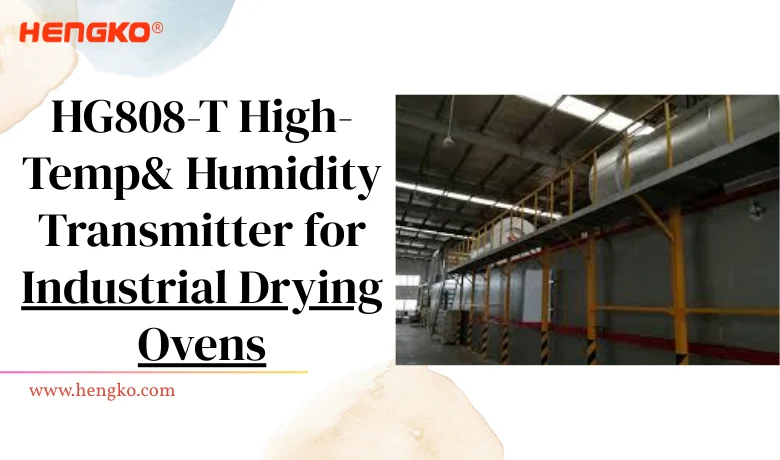
They are suitable for local control loops, individual dryers, ovens, kilns, and independent production lines.
Networked Monitoring
Networked systems combine data from multiple transmitters to support centralized alarms, plant-wide monitoring, historical trending, and energy analysis.
A networked system can help compare:
- Different zones within one dryer
- Multiple production lines
- Different product batches
- Energy performance between shifts
- Long-term process consistency
Calibration and Verification
During commissioning:
- Compare new transmitters with a suitable reference instrument.
- Verify readings during startup, stable operation, and cooling.
- Confirm that analog and digital outputs agree with the local display.
- Check PLC scaling and engineering units.
- Verify alarm thresholds and delays.
- Document the initial readings for future maintenance comparison.
Periodic verification may be scheduled every 6–12 months, depending on process contamination, thermal cycling, required accuracy, and quality procedures.
Dusty, corrosive, or condensation-prone applications may require more frequent inspection and calibration.
PLC, DCS, and SCADA Integration
| Output | Typical Use |
|---|---|
| 4-20 mA | Direct PLC input, control loops, analog alarms, and long-distance signal transmission. |
| Modbus RTU | Digital trending, centralized monitoring, diagnostics, maintenance data, and multi-point networks. |
| Local Display | On-site verification, commissioning, maintenance inspection, and operator checks. |
High-Temperature Drying Transmitter Selection Checklist
✓ Confirm the normal and maximum continuous process temperature.
✓ Confirm the expected relative humidity or dew point range.
✓ Identify dust, powder, oil vapor, chemicals, or corrosive gases.
✓ Confirm whether condensation can occur during startup or shutdown.
✓ Select the required probe length and installation connection.
✓ Confirm the process pressure and air velocity.
✓ Keep the transmitter electronics within their permitted temperature range.
✓ Choose 4–20 mA, Modbus RTU, or the required control-system output.
✓ Define acceptable accuracy, response time, and calibration interval.
✓ Confirm that the probe can be inspected, cleaned, or replaced without excessive downtime.
Często zadawane pytania
Can one transmitter measure both temperature and humidity?
Yes. The HG808-T is designed to provide temperature and relative humidity measurements from one probe assembly, allowing both parameters to be monitored at the same process location.
Can the HG808-T be installed directly inside an industrial oven?
The probe can be installed at the process measurement point when its specified temperature, pressure, and environmental limits are respected. The transmitter electronics should remain within their permitted ambient temperature range.
How many sensors are required for one dryer?
The number depends on dryer size, airflow pattern, product sensitivity, and required process visibility. A basic system may use one inlet sensor and one outlet sensor, while larger chambers may require multiple measurement points.
Can the transmitter connect directly to a PLC?
Yes. A 4–20 mA output can connect to a compatible analog PLC input, while Modbus RTU can be used for digital communication, multi-point monitoring, diagnostics, and historical trending.
How often should the transmitter be calibrated?
A typical verification interval may be 6–12 months. More frequent checks may be required in processes with heavy dust, chemical exposure, condensation, strong thermal cycling, or strict quality-control requirements.
What causes humidity readings to change suddenly?
Sudden changes may be caused by door leakage, changing product load, fan failure, airflow interruption, steam entry, condensation, sensor contamination, or an electrical connection problem.
Is relative humidity always the best parameter for drying control?
Not always. Relative humidity is highly dependent on temperature. Some processes may also benefit from dew point, absolute humidity, moisture content, or product-moisture measurements. The correct parameter depends on the drying objective.
Wnioski
Precise temperature and humidity monitoring is essential in industrial drying processes. These two parameters influence drying speed, product quality, energy consumption, equipment condition, and operational safety.
Reliable monitoring requires more than selecting a sensor with a high maximum temperature. Plant operators must also consider sensor placement, condensation, process contamination, airflow, pressure, signal integration, calibration, and maintenance access.
The HENGKO HG808-T high-temperature humidity and temperature transmitter provides continuous process measurements and industrial outputs for integration with PLC, DCS, and SCADA systems.
By selecting the correct probe configuration, installing it at representative measurement points, and using trend data effectively, operators can reduce product defects, minimize energy waste, improve equipment reliability, and maintain more consistent drying performance.
Need a High-Temperature Humidity Monitoring Solution?
Contact HENGKO to discuss your drying temperature, humidity range, probe length, process connection, output signal, and installation environment.
Email: sales@hengkometer.com