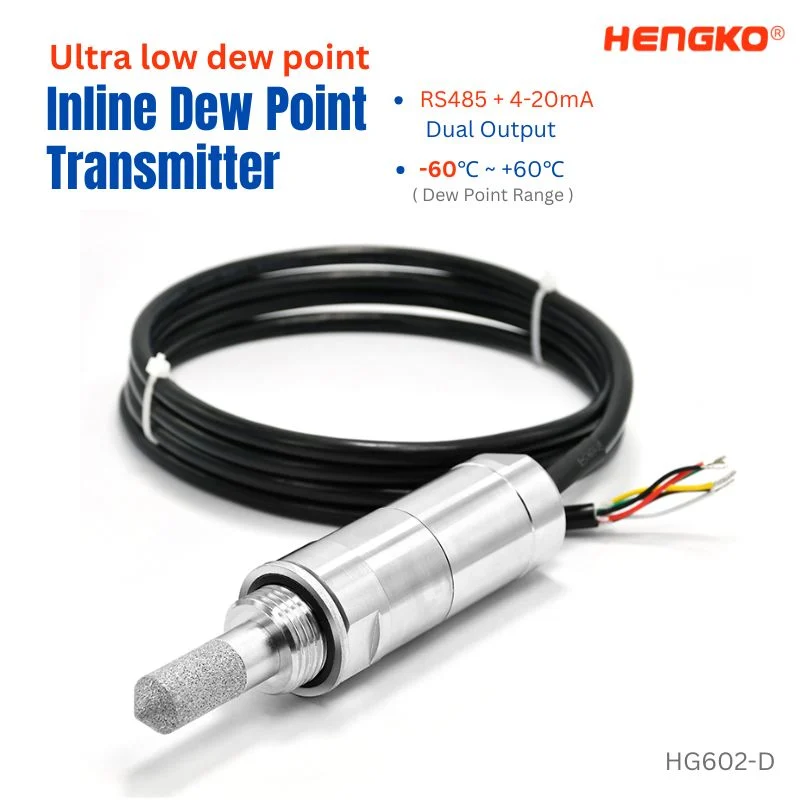

Stable and Accurate Dew Point Monitoring for Industrial and Environmental Applications
The HG602-D is a compact, high-reliability transmitter for dew point, temperature, and humidity measurement in environments up to 60 °C (140 °F).
-It delivers ±2 °C Td accuracy, fast response, and long-term stability, making it ideal for compressed air systems, HVAC monitoring, and industrial drying processes.
-The sensor’s condensation-resistant design ensures accurate readings even under high humidity or fluctuating ambient conditions.
Key Highlights:
*Operating Temperature: −40 ~ +60 °C
*Dew Point Range: −60 ~ +60 °C (−76 ~ +140 °F)
*Accuracy: ±2 °C Td (±3.6 °F)
*Output Options: RS-485 (Modbus-RTU) + 4–20 mA / 0–5 V / 0–10 V
*Condensation Resistance: Sensor remains dry and stable under high humidity
*Wide Power Supply: 10 – 28 V DC with polarity protection
*Strong Compatibility: Standard Modbus protocol for seamless system integration
Ideal para:
Compressed Air | HVAC | Industrial Drying | Environmental Control
📩 Contact us to customize your HG602-D dew point monitoring solution today.
| Modelo | Salida (T: Temperatura, H: Humedad, DP: Punto de rocío) | Rango de punto de rocío | Temperatura | Rango de humedad | Resiste la condensación |
|---|---|---|---|---|---|
| HG602- D | T + H + DP (lectura simultánea) + (4 - 20 mA), T - H - DP (elegir 1 de 3) | -60 ~ +60°C (puede ajustarse dentro del intervalo) | -40 ~ 60°C | 0 ~ 100%RH | Y |
🔹Features
| Categoría | Características y especificaciones técnicas |
|---|---|
| Alimentación | DC 10V ~ 30V (se recomienda fuente de alimentación de 12V) |
| Disipación de potencia | <0.1W |
| Rango de punto de rocío | -60 ~ +60°C (puede ajustarse dentro del intervalo) |
| Work Temperature range | -40 ~ +60°C |
| Rango de humedad | 0 ~ 100%RH ( <90%RH recomendado) |
| Salida analógica | Temperatura, Humedad, Punto de rocío (elija 1 de 3) |
| Salida RS485 | Temperatura, humedad, punto de rocío (lectura simultánea) |
| Precisión típica (20°C, 50%RH, Una atmósfera estándar) | |
| Temperatura | ±0.1°C |
| Punto de rocío | ±2 °C (±3.6℉)Td Accuracy (Dew Point) |
| Humedad | ±1,5%RH |
| Resolución de salida digital | 0,01°C / 0,1°C seleccionable<br>0,01%RH / 0,1%RH seleccionable |
| Velocidad de comunicación en baudios | 1200, 2400, 4800, 9600, 19200, 115200 configurable, por defecto 9600 pbs |
| Salida (simultánea) | 1 ruta: 4 ~ 20mA (RL≤500Ω)<br>1 ruta: RS485 Modbus-RTU Puerto de comunicaciones Modbus: RTU,9.6k/19.2k/38.4k/57.6k/115.2kBaud |
| Frecuencia de adquisición | La respuesta más rápida 1s, otros pueden ser fijados por el PLC |
| Formato byte | 8 bits de datos, 1 bit de parada, sin comprobación |
| Presión | 16 bar |
Número de pedido :
| Modelo | Salida de señal | Valor de salida | Rango de punto de rocío | Rango de temperatura |
|---|---|---|---|---|
| HG602-D4 | 4-20 mA + RS485 | Punto de rocío | -60 a 60 °C | -40 to60 °C |
| HG602-D5 | 0-5v + RS 485 | Punto de rocío | -60 a 60 °C | -40 to 60 °C |
| HG602-D1 | 0-10v + RS 485 | Punto de rocío | -60 a 60 °C | -40 to 60 °C |
Se trata de una galería para mostrar imágenes de tus publicaciones sociales recientes
Why Standard Humidity Sensors Fail in High-Temperature Environments Quick Summary Standard humidity sensors are mainly designed for ambient or moderate industrial conditions. Under sustained high temperatures, steam, contaminants, and repeated thermal cycling, they can suffer from material degradation, measurement drift, condensation damage, and shortened service life. This article explains the most common failure mechanisms and
How to Monitor Temperature and Humidity in High-Temperature Industrial Drying Processes Quick Summary Industrial drying processes used in pharmaceuticals, food production, chemicals, ceramics, and materials manufacturing require precise control of temperature and humidity. Even small deviations can cause product defects, excessive energy consumption, longer drying cycles, or equipment damage. This guide explains why high-temperature drying
High-Temperature Humidity Transmitter for 200℃ Industrial Drying Ovens-HG808-T In many manufacturing processes, drying is more than just a step — it’s a decisive factor that directly affects product quality, production efficiency, and energy consumption. Whether you’re drying ceramics, powder materials, food ingredients, coatings, lithium battery materials, or industrial components, temperature and moisture inside the drying
Effective moisture management is essential in facilities where materials, equipment, and processes depend on controlled environmental conditions. While dehumidifiers play a central role, their performance—and efficiency—largely depends on accurate temperature and humidity monitoring. With advanced transmitters providing continuous, real-time environmental data, dehumidifiers can operate intelligently rather than blindly, ensuring consistent protection and optimal operating costs.
In short, Humidity and temperature transmitters measure and send environmental data to control systems. They are widely used in HVAC, pharmaceuticals, food processing, and cleanrooms where precise conditions are critical. Sensing: Built-in humidity and temperature sensors detect moisture and heat changes. Signal Conversion: The device converts raw signals into standard outputs like 4–20 mA or
Why Are Dryer Dew Point Meters Critical for Compressed Air Systems? Maybe You always battle hidden moisture in compressed air that can cause corrosion, freezing, and product defects. By installing dew point meters, you detect and stop moisture issues before equipment fails. You can monitor dew point to prevent condensation and protect assets. The HENGKO
Why One Office Zone is Too Humid & How a Humidity Transmitter Fixes It Persistent humidity in one office zone can disrupt comfort, increase mold risk, and hurt productivity. Even with your HVAC system running, one area may stay damp due to hidden airflow issues or localized moisture sources. A humidity transmitter acts like a
Introduction Compressed air is often referred to as the “fourth utility” in modern industry, alongside electricity, water, and gas. Yet, one of the most common issues facing compressed air systems is moisture. When untreated, moisture can lead to corrosion, blocked pipelines, damaged pneumatic equipment, and compromised product quality. To address this, refrigerated air dryers—commonly known
1. Introduction The semiconductor industry operates under some of the most stringent environmental conditions of any manufacturing sector. As devices shrink to the nanoscale and production processes grow increasingly complex, maintaining precise control over environmental parameters—particularly temperature and humidity—has become critical to ensuring consistent quality and yield. Even slight fluctuations in temperature or humidity can
Introduction In the world of environmental simulation and reliability testing, constant temperature and humidity chambers are indispensable tools across a wide range of industries—from electronics and pharmaceuticals to materials science and aerospace. These chambers are engineered to maintain a precisely controlled climate, ensuring stable temperature and relative humidity (RH) for extended testing cycles. But what