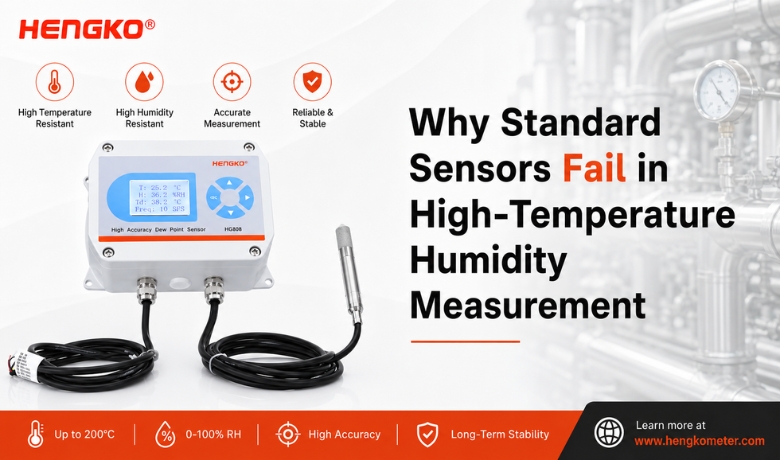
Why Standard Humidity Sensors Fail in High-Temperature Environments
Standard humidity sensors are mainly designed for ambient or moderate industrial conditions. Under sustained high temperatures, steam, contaminants, and repeated thermal cycling, they can suffer from material degradation, measurement drift, condensation damage, and shortened service life.
This article explains the most common failure mechanisms and why purpose-built, industrial-grade humidity transmitters are necessary for reliable process control.
In This Article
1. Why high-temperature humidity measurement is different
2. Seven reasons standard humidity sensors fail
3. Standard sensors versus industrial transmitters
4. Typical high-temperature applications
5. How to select the right measurement solution
6. Frequently asked questions
Key Takeaways
✓ Sustained heat accelerates sensor aging and calibration drift.
✓ Polymer-based sensing elements can lose stability under prolonged thermal exposure.
✓ Condensation is a major cause of permanent sensor damage.
✓ Dust, chemicals, vibration, and pressure changes further reduce sensor life.
✓ Industrial high-temperature transmitters are designed for continuous operation in harsh processes.
Why High-Temperature Humidity Measurement Is Different
Humidity measurement is relatively straightforward under normal ambient conditions. Offices, warehouses, laboratories, and HVAC systems usually operate within the range that standard humidity sensors are designed to handle.
Industrial processes are significantly more demanding.
Drying ovens, sintering furnaces, sterilization systems, exhaust ducts, kilns, and thermal processing equipment can expose a sensor to continuous heat, rapid temperature changes, steam, dust, vibration, and chemically aggressive gases.
At elevated temperatures, humidity measurement is no longer only about detecting moisture. It becomes a combined challenge involving:
- Thermal stress on sensing materials
- Accelerated aging and measurement drift
- Condensation and re-evaporation cycles
- Chemical exposure and particulate contamination
- Mechanical expansion and contraction
- Pressure changes and process vibration
High-temperature sensor failure is rarely caused by one factor alone. In most industrial processes, heat, condensation, contamination, vibration, and pressure changes act together to accelerate sensor aging.
1. Sensor Materials Degrade Under Sustained Heat
Most conventional humidity sensors use polymer-based capacitive sensing elements. These elements are cost-effective, responsive, and suitable for many moderate-temperature applications.
However, polymer materials are sensitive to prolonged heat. Under sustained high-temperature exposure, the sensing layer may:
- Lose elasticity
- Experience permanent structural changes
- Absorb and release moisture less consistently
- Become less responsive to humidity variations
- Shift away from its original calibration
The sensor may not stop working immediately. Instead, it can continue producing a signal while gradually becoming less accurate.
A sensor that still outputs data is not necessarily producing trustworthy data. Silent measurement drift can be more damaging than a complete and obvious failure.
2. Temperature-Induced Drift Overwhelms Compensation Algorithms
Humidity measurement depends heavily on accurate temperature compensation.
Standard sensors usually apply compensation models developed for a limited operating range. Once the process temperature moves well beyond that range, the model may no longer reflect the actual behavior of the sensing material.
Common causes of compensation error include:
- Non-linear temperature and humidity interactions
- Rapid heating and cooling cycles
- Uneven thermal distribution across the probe
- Temperature gradients between the sensor and process gas
- Changes in sensing-material behavior at elevated temperatures
These effects can cause:
- Progressive baseline drift
- Unstable readings
- Poor repeatability
- Increased differences between identical sensors
- Frequent recalibration requirements
Recalibration may temporarily correct the output, but it cannot eliminate continued material aging or thermal stress.
3. Condensation Cycles Cause Permanent Sensor Damage
A process can operate at a high temperature and still expose the sensor to condensation.
Condensation commonly occurs during:
- Equipment startup
- Process shutdown
- Rapid cooling
- Steam cleaning
- Load changes
- Temporary loss of heat
- Contact with a cooler probe surface
When warm, moisture-rich gas reaches a cooler surface, liquid water can form directly on the sensor.
Repeated condensation may lead to:
- Saturation of the sensing element
- Slow recovery after wetting
- Water ingress into internal electronics
- Corrosion of electrical connections
- Contamination being deposited on the sensing surface
- Irreversible changes in calibration
The maximum process temperature alone does not determine sensor suitability. Startup, shutdown, cleaning, and cooling conditions must also be evaluated.
4. Mechanical and Structural Limits Are Exceeded
The sensing element is only one part of the measurement system.
Standard humidity sensors may also contain housings, seals, cables, adhesives, circuit boards, and protective caps that are not suitable for prolonged high-temperature operation.
Typical mechanical weaknesses include:
- Plastic housings that soften or deform
- Seals and gaskets that harden or degrade
- Adhesives that lose strength
- Cable insulation that becomes brittle
- Poor resistance to vibration
- Stress caused by thermal expansion and contraction
- Inadequate protection against pressure changes
Even when the sensing element remains functional, structural damage can create air leakage, unstable electrical connections, or inaccurate readings.
5. Chemical and Particulate Exposure Accelerates Failure
High-temperature process gas is rarely clean.
Depending on the application, the gas stream may contain:
- Oil vapor and aerosols
- Solvents
- Combustion byproducts
- Acidic or alkaline compounds
- Fine dust
- Fibers
- Metal particles
- Product residues
At elevated temperatures, chemical reactions and diffusion processes occur more quickly. This increases the likelihood of sensor fouling, corrosion, or permanent contamination.
Standard sensors may lack:
- Protective sintered filters
- Corrosion-resistant probe materials
- Replaceable protective elements
- High-temperature-compatible seals
- Probe structures that isolate sensitive electronics
- Designs that allow cleaning or maintenance
As contaminants accumulate, sensor response may become slower and less repeatable. In severe cases, the sensing element can fail completely.
6. Maximum Temperature Ratings Are Often Misunderstood
A common selection mistake is assuming that the highest temperature shown on a datasheet represents the sensor’s continuous operating capability.
In practice, different temperature ratings may refer to:
- Continuous operating temperature
- Short-term exposure temperature
- Storage temperature
- Non-operating temperature
- Probe temperature
- Electronics temperature
These values are not interchangeable. A probe may tolerate a high process temperature while the transmitter electronics must remain in a cooler location.
Do not compare sensors using only the maximum temperature shown in a datasheet. Confirm whether the value applies to the sensing element, probe, cable, housing, or transmitter electronics, and whether it is suitable for continuous operation.
7. Data Reliability Declines Before Complete Failure
Humidity sensors rarely fail in a single, obvious event. More often, the quality of the measurement deteriorates gradually before the device stops working.
Common warning signs include:
- Gradual baseline drift
- Increased signal noise
- Slow response to process changes
- Reduced repeatability
- Different readings from identical sensors
- Frequent need for recalibration
- Unexplained process-control fluctuations
Poor humidity data can contribute to:
- Incomplete drying
- Excessive drying
- Product quality variation
- Increased energy consumption
- Longer production cycles
- Rework or rejected batches
- Unplanned maintenance
- Process downtime
In many industrial applications, the cost of inaccurate humidity data is substantially higher than the purchase price of the sensor.
Standard Sensors vs. Industrial High-Temperature Transmitters
Industrial-grade transmitters are designed around the actual conditions found in thermal processes. The differences extend beyond the stated temperature range.
| Caratteristica | Standard Humidity Sensor | Industrial High-Temperature Transmitter |
|---|---|---|
| Continuous high-temperature operation | Usually limited | Designed for specified continuous-duty conditions |
| Sensing-material stability | Suitable for moderate conditions | Selected for wider thermal exposure |
| Temperature compensation | Optimized for a narrower range | Developed for wider operating ranges |
| Condensation resistance | Often limited | Improved through probe and protection design |
| Chemical resistance | Depends on basic housing materials | Available with corrosion-resistant probe materials |
| Particulate protection | Basic protective cap | Protective filters or sintered probe structures |
| Mechanical durability | General-purpose construction | Designed for vibration, thermal cycling, and harsh installation conditions |
| Signal output | Often local or low-level output | Commonly available with 4–20 mA, RS485, or Modbus |
| Maintenance design | Limited serviceability | May support replaceable filters, calibration, or remote probe installation |
No sensor is universally suitable for every high-temperature application. Actual performance depends on temperature, pressure, gas composition, condensation risk, installation method, and required accuracy.
Why Industrial-Grade High-Temperature Humidity Transmitters Exist
High-temperature humidity measurement requires a purpose-built system rather than a standard sensor placed inside a stronger housing.
An industrial solution may include:
- High-temperature-resistant sensing materials
- Wide-range temperature compensation
- A remote probe that separates the sensing point from the electronics
- Stainless steel or corrosion-resistant probe construction
- Protective sintered filters for dusty gas streams
- Condensation-resistant mechanical design
- Industrial electrical connections
- Stable analog or digital outputs
- Calibration procedures suitable for process instrumentation
Most importantly, the complete transmitter must be designed for long-term, continuous operation rather than occasional exposure.
Typical Applications Where Standard Sensors Fail
High-temperature humidity measurement is commonly required in:
- Industrial drying and curing ovens
- Ceramic kilns
- Metal sintering furnaces
- Heat-treatment processes
- Food baking and drying equipment
- Pharmaceutical sterilization systems
- Textile drying lines
- Paper and pulp drying systems
- Flue gas and process exhaust monitoring
- Coating and curing processes
- Building-material production
- High-temperature air ducts
In these environments, a standard sensor may require frequent replacement or recalibration while still failing to provide stable process data.
How to Select the Right Humidity Measurement Solution
A reliable selection process should consider the entire operating environment, not only the normal process temperature.
1. Confirm the Real Temperature Conditions
- Normal operating temperature
- Maximum continuous temperature
- Short-term peak temperature
- Startup and shutdown temperature
- Probe temperature
- Ambient temperature around the electronics
2. Evaluate Moisture and Condensation Risk
- Expected relative humidity
- Steam exposure
- Saturated gas conditions
- Dew point during cooling
- Washdown or cleaning cycles
- Frequency of condensation events
3. Review the Process Gas
- Solvents
- Oil vapor
- Acidic compounds
- Combustion gases
- Fine particles
- Dust or fibers
- Product residue
4. Check Mechanical Requirements
- Process pressure
- Air or gas velocity
- Vibration
- Installation depth
- Probe orientation
- Thread or flange connection
- Required cable length
- Accessibility for maintenance
5. Define Measurement and Control Requirements
- Required accuracy
- Tempo di risposta
- Long-term drift tolerance
- 4–20 mA output requirements
- RS485 or Modbus communication
- PLC or DCS compatibility
- Calibration interval
- Need for a local display
Compare the total cost of ownership, including recalibration, replacement labor, downtime, and product losses, rather than evaluating only the initial sensor price.
Domande frequenti
Can a standard humidity sensor operate above 100°C?
Some sensors can tolerate brief exposure above 100°C, but this does not automatically mean they are suitable for continuous operation. The allowed temperature may apply only to the probe, storage conditions, or short-duration exposure. Always verify the continuous operating limit for the complete sensor assembly.
Why can condensation occur inside a hot process?
Condensation occurs when a surface temperature falls below the dew point of the surrounding gas. During startup, shutdown, or rapid cooling, the probe may be colder than the moisture-rich process gas, causing liquid water to form on the sensor.
What is the most common sign of heat-related sensor damage?
Gradual measurement drift is one of the most common signs. The sensor may still respond to humidity changes, but its baseline, repeatability, or agreement with a reference instrument progressively worsens.
Does a protective filter solve all high-temperature problems?
No. A protective filter can reduce dust and particulate contamination, but it does not correct sensing-material limitations, inadequate temperature compensation, condensation damage, or overheating of the electronics.
Should relative humidity or dew point be measured at high temperatures?
The best parameter depends on the process objective. Relative humidity changes strongly with temperature, while dew point or absolute moisture measurements may provide more direct information about the actual water-vapor content. The measurement method should be selected according to the process-control requirement.
Why are remote-probe transmitters used in high-temperature applications?
A remote probe allows the sensing point to be installed in the hot gas stream while keeping temperature-sensitive electronics in a cooler location. This can improve reliability and simplify installation and maintenance.
Conclusione
Standard humidity sensors are not inherently unreliable. They are simply designed for different operating conditions.
When exposed to sustained high temperatures, steam, contaminants, thermal cycling, vibration, and continuous industrial operation, their design limitations become increasingly important. Material degradation, temperature-induced drift, condensation damage, mechanical stress, and contamination can all reduce measurement accuracy long before complete sensor failure occurs.
Industrial-grade high-temperature humidity transmitters address these challenges through appropriate sensing materials, wider temperature compensation, robust probe construction, protective filtration, and industrial signal integration.
For demanding thermal processes, choosing the correct humidity measurement technology is an essential part of protecting process stability, product quality, energy efficiency, and long-term operational reliability.