Startseite " Portfolio " Hochpräziser Inline-Taupunktsensor 4-20mA HG602-D

Stable and Accurate Dew Point Monitoring for Industrial and Environmental Applications
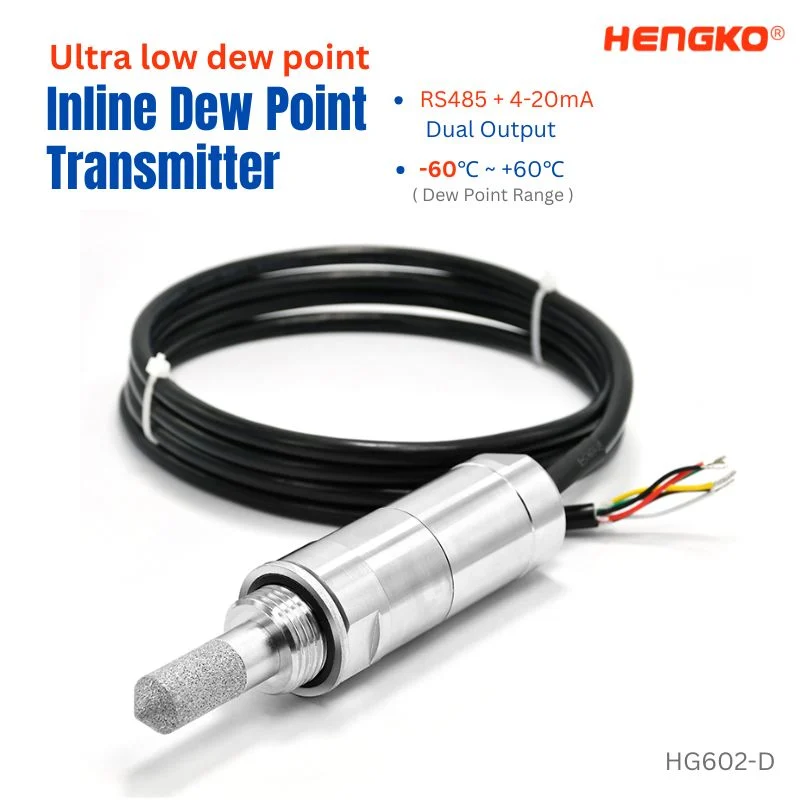
The HG602-D is a compact, high-reliability transmitter for dew point, temperature, and humidity measurement in environments up to 60 °C (140 °F).
-It delivers ±2 °C Td accuracy, fast response, and long-term stability, making it ideal for compressed air systems, HVAC monitoring, and industrial drying processes.
-The sensor’s condensation-resistant design ensures accurate readings even under high humidity or fluctuating ambient conditions.
Key Highlights:
*Operating Temperature: −40 ~ +60 °C
*Dew Point Range: −60 ~ +60 °C (−76 ~ +140 °F)
*Accuracy: ±2 °C Td (±3.6 °F)
*Output Options: RS-485 (Modbus-RTU) + 4–20 mA / 0–5 V / 0–10 V
*Condensation Resistance: Sensor remains dry and stable under high humidity
*Wide Power Supply: 10 – 28 V DC with polarity protection
*Strong Compatibility: Standard Modbus protocol for seamless system integration
Ideal for:
Compressed Air | HVAC | Industrial Drying | Environmental Control
📩 Contact us to customize your HG602-D dew point monitoring solution today.
| Modell | Ausgang (T: Temperatur, H: Luftfeuchtigkeit, DP: Taupunkt) | Taupunktbereich | Temperaturbereich | Luftfeuchtigkeitsbereich | Widersteht Kondenswasser |
|---|---|---|---|---|---|
| HG602- D | T + H + DP (read simultaneously) + (4 – 20 mA), T – H – DP (choose 1 from 3) | -60 ~ +60°C (can be set within the range) | -40 ~ 60°C | 0 ~ 100%RH | Y |
🔹Features
| Kategorie | Technische Daten und Merkmale |
|---|---|
| Stromversorgung | DC 10V ~ 30V (12V-Netzteil empfohlen) |
| Verlustleistung | <0.1W |
| Taupunktbereich | -60 ~ +60°C (can be set within the range) |
| Work Temperature range | -40 ~ +60°C |
| Luftfeuchtigkeitsbereich | 0 ~ 100%RH ( <90%RH empfohlen) |
| Analoger Ausgang | Temperatur, Luftfeuchtigkeit, Taupunkt (wählen Sie 1 aus 3) |
| RS485-Ausgang | Temperatur, Luftfeuchtigkeit, Taupunkt (gleichzeitige Anzeige) |
| Typische Genauigkeit (20°C, 50%RH, eine Standardatmosphäre) | |
| Temperatur | ±0.1°C |
| Taupunkt | ±2 °C (±3.6℉)Td Accuracy (Dew Point) |
| Luftfeuchtigkeit | ±1,5%RH |
| Auflösung des digitalen Ausgangs | 0,01°C / 0,1°C wählbar<br>0,01%RH / 0,1%RH wählbar |
| Baudrate der Kommunikation | 1200, 2400, 4800, 9600, 19200, 115200 einstellbar, Standard 9600 pbs |
| Ausgabe (gleichzeitig) | 1 Strecke: 4 ~ 20mA (RL≤500Ω)<br>1 Strecke: RS485 Modbus-RTU Modbus communications port: RTU,9.6k/19.2k/38.4k/57.6k/115.2kBaud |
| Erfassungshäufigkeit | Die schnellste 1s-Antwort, andere können vom PLC eingestellt werden |
| Byte-Format | 8 Datenbits, 1 Stoppbit, keine Prüfung |
| Druck | 16 bar |
Bestellnummer :
| Modell | Signalausgang | Ausgangswert | Taupunktbereich | Temperaturbereich |
|---|---|---|---|---|
| HG602-D4 | 4-20 mA + RS485 | Taupunkt | -60 to 60 °C | -40 bis 60 °C |
| HG602-D5 | 0-5v + RS 485 | Taupunkt | -60 to 60 °C | -40 bis 60 °C |
| HG602-D1 | 0-10v + RS 485 | Taupunkt | -60 to 60 °C | -40 bis 60 °C |
Dies ist eine Galerie, in der Sie Bilder aus Ihren letzten sozialen Beiträgen präsentieren können.
Why Standard Humidity Sensors Fail in High-Temperature Environments Quick Summary Standard humidity sensors are mainly designed for ambient or moderate industrial conditions. Under sustained high
How to Monitor Temperature and Humidity in High-Temperature Industrial Drying Processes Quick Summary Industrial drying processes used in pharmaceuticals, food production, chemicals, ceramics, and materials
High-Temperature Humidity Transmitter for 200℃ Industrial Drying Ovens-HG808-T In many manufacturing processes, drying is more than just a step — it’s a decisive factor that
Effective moisture management is essential in facilities where materials, equipment, and processes depend on controlled environmental conditions. While dehumidifiers play a central role, their performance—and
Kurz gesagt, Feuchte- und Temperaturtransmitter messen und senden Umgebungsdaten an Kontrollsysteme. Sie werden häufig in den Bereichen HLK, Pharmazeutika, Lebensmittelverarbeitung und Reinräume eingesetzt.
Warum sind Trockner-Taupunktmessgeräte für Druckluftsysteme so wichtig? Vielleicht kämpfen Sie immer mit versteckter Feuchtigkeit in der Druckluft, die Korrosion und Einfrieren verursachen kann,
Warum eine Bürozone zu feucht ist und wie ein Feuchtigkeitsmessgerät Abhilfe schafft Anhaltende Feuchtigkeit in einer Bürozone kann den Komfort stören und zu Schimmel führen
Einleitung Druckluft wird in der modernen Industrie oft als "vierte Energiequelle" neben Strom, Wasser und Gas bezeichnet. Dennoch ist eine der häufigsten
1. Einleitung Die Halbleiterindustrie arbeitet unter einigen der strengsten Umweltbedingungen aller Fertigungsbereiche. Da die Bauelemente bis in den Nanobereich schrumpfen und
Einführung In der Welt der Umweltsimulation und der Zuverlässigkeitsprüfung sind Kammern mit konstanter Temperatur und Luftfeuchtigkeit in vielen Industriezweigen unverzichtbar - von der Elektronik bis hin zu
WhatsApp uns