Casa " Portafoglio " Sensore di punto di rugiada in linea ad alta precisione 4-20mA HG602-D
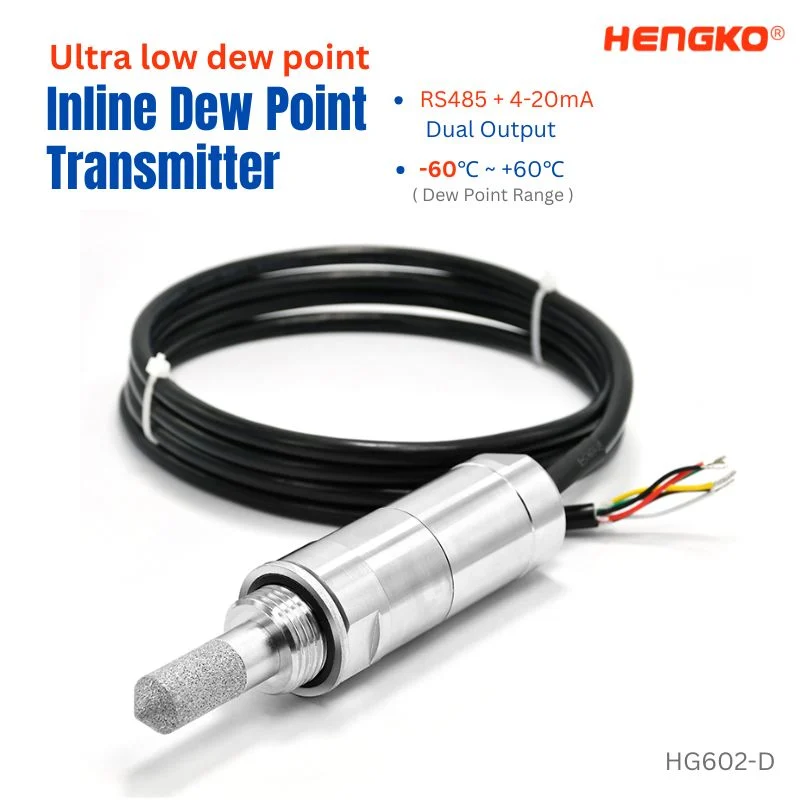

Stable and Accurate Dew Point Monitoring for Industrial and Environmental Applications
The HG602-D is a compact, high-reliability transmitter for dew point, temperature, and humidity measurement in environments up to 60 °C (140 °F).
-It delivers ±2 °C Td accuracy, fast response, and long-term stability, making it ideal for compressed air systems, HVAC monitoring, and industrial drying processes.
-The sensor’s condensation-resistant design ensures accurate readings even under high humidity or fluctuating ambient conditions.
Key Highlights:
*Operating Temperature: −40 ~ +60 °C
*Dew Point Range: −60 ~ +60 °C (−76 ~ +140 °F)
*Accuracy: ±2 °C Td (±3.6 °F)
*Output Options: RS-485 (Modbus-RTU) + 4–20 mA / 0–5 V / 0–10 V
*Condensation Resistance: Sensor remains dry and stable under high humidity
*Wide Power Supply: 10 – 28 V DC with polarity protection
*Strong Compatibility: Standard Modbus protocol for seamless system integration
Ideal for:
Compressed Air | HVAC | Industrial Drying | Environmental Control
📩 Contact us to customize your HG602-D dew point monitoring solution today.
| Modello | Uscita (T: temperatura, H: umidità, DP: punto di rugiada) | Intervallo del punto di rugiada | Intervallo di temperatura | Intervallo di umidità | Resiste alla condensa |
|---|---|---|---|---|---|
| HG602- D | T + H + DP (lettura simultanea) + (4 - 20 mA), T - H - DP (scegliere 1 da 3) | -60 ~ +60°C (può essere impostato all'interno dell'intervallo) | -40 ~ 60°C | 0 ~ 100%RH | Y |
🔹Features
| Categoria | Specifiche tecniche e caratteristiche |
|---|---|
| Alimentazione | DC 10V ~ 30V (si consiglia l'alimentazione a 12V) |
| Dissipazione di potenza | <0.1W |
| Intervallo del punto di rugiada | -60 ~ +60°C (può essere impostato all'interno dell'intervallo) |
| Work Temperature range | -40 ~ +60°C |
| Intervallo di umidità | 0 ~ 100%RH (si consiglia <90%RH) |
| Uscita analogica | Temperatura, Umidità, Punto di rugiada (scegliere 1 da 3) |
| Uscita RS485 | Temperatura, umidità, punto di rugiada (lettura simultanea) |
| Precisione tipica (20°C, 50%RH, un'atmosfera standard) | |
| Temperatura | ±0.1°C |
| Punto di rugiada | ±2 °C (±3.6℉)Td Accuracy (Dew Point) |
| Umidità | ±1,5%RH |
| Risoluzione dell'uscita digitale | 0,01°C / 0,1°C selezionabile<br>0,01%RH / 0,1%RH selezionabile |
| Velocità di comunicazione in baud | 1200, 2400, 4800, 9600, 19200, 115200 impostabile, default 9600 pbs |
| Uscita (simultaneamente) | 1 percorso: 4 ~ 20mA (RL≤500Ω)<br>1 percorso: RS485 Modbus-RTU Porta di comunicazione Modbus: RTU,9.6k/19.2k/38.4k/57.6k/115.2kBaud |
| Frequenza di acquisizione | La risposta più veloce è di 1s, le altre possono essere impostate dal PLC. |
| Formato del byte | 8 bit di dati, 1 bit di stop, nessun controllo |
| Pressione | 16 bar |
Numero d'ordine :
| Modello | Segnale in uscita | Valore di uscita | Intervallo del punto di rugiada | Intervallo di temperatura |
|---|---|---|---|---|
| HG602-D4 | 4-20 mA + RS485 | Punto di rugiada | Da -60 a 60 °C | -40 to60 °C |
| HG602-D5 | 0-5v + RS 485 | Punto di rugiada | Da -60 a 60 °C | -40 to 60 °C |
| HG602-D1 | 0-10v + RS 485 | Punto di rugiada | Da -60 a 60 °C | -40 to 60 °C |
Si tratta di una galleria per mostrare le immagini dei vostri post recenti sui social.
Why Standard Humidity Sensors Fail in High-Temperature Environments Quick Summary Standard humidity sensors are mainly designed for ambient or moderate industrial conditions. Under sustained high
How to Monitor Temperature and Humidity in High-Temperature Industrial Drying Processes Quick Summary Industrial drying processes used in pharmaceuticals, food production, chemicals, ceramics, and materials
High-Temperature Humidity Transmitter for 200℃ Industrial Drying Ovens-HG808-T In many manufacturing processes, drying is more than just a step — it’s a decisive factor that
Effective moisture management is essential in facilities where materials, equipment, and processes depend on controlled environmental conditions. While dehumidifiers play a central role, their performance—and
In breve, i trasmettitori di umidità e temperatura misurano e inviano dati ambientali ai sistemi di controllo. Sono ampiamente utilizzati nei settori HVAC, farmaceutico, alimentare e delle camere bianche.
Perché i misuratori del punto di rugiada degli essiccatori sono fondamentali per i sistemi ad aria compressa? Forse si combatte sempre contro l'umidità nascosta nell'aria compressa che può causare corrosione e congelamento,
Perché una zona dell'ufficio è troppo umida e come un trasmettitore di umidità la risolve L'umidità persistente in una zona dell'ufficio può compromettere il comfort, aumentare la muffa e ridurre il rischio di danni.
Introduzione L'aria compressa è spesso definita la "quarta utility" dell'industria moderna, insieme a elettricità, acqua e gas. Tuttavia, una delle più comuni
1. L'industria dei semiconduttori opera in condizioni ambientali tra le più severe di qualsiasi altro settore produttivo. Man mano che i dispositivi si restringono su scala nanometrica e
Introduzione Nel mondo della simulazione ambientale e dei test di affidabilità, le camere a temperatura e umidità costanti sono strumenti indispensabili in un'ampia gamma di settori, dall'elettronica al design.